
You've seen the landscape overview—blockchain, CBDCs, cloud-native bank networks, interoperability initiatives. You know the categories. What you probably don't have is a practical framework for choosing payment infrastructure when you're actually building a product that needs to move money across borders in seconds.
Whether you're a fintech building remittance rails, one of the many financial institutions modernizing cross-border payments, or a platform looking for payment solutions that actually settle in real time, the technology category matters less than operational reality. Real-time cross-border settlement is the ability to transfer and irrevocably settle funds across jurisdictions in seconds to minutes, 24/7/365, with transparent costs. This guide covers what to evaluate, how modern settlement flows work, and how a multi-rail API approach delivers real-time cross-border payments in production.
How to Evaluate Real-Time Cross-Border Settlement Infrastructure
The technology category matters less than operational reality. A blockchain system that can't connect to local banking rails isn't useful. A bank-led initiative with three-day cross-border clearing isn't real-time. Here's what to evaluate.
Settlement Finality and Speed
Speed and finality are different things. A payment can appear fast—funds show as pending within seconds—but settlement finality means the transaction is irrevocable and the recipient has unconditional access to the funds. Many "near-real-time" claims mask provisional crediting or batch settlement systems behind the scenes.
This distinction matters for your product. If you're building payroll and a real-time payment reverses after the recipient sees a balance, you have a support nightmare. If you're building B2B payments, provisional settlement creates counterparty risk and disrupts cash flow for your customers.
Questions to ask:
- What is the actual time to finality—not time to status change, but irrevocable settlement?
- Is settlement atomic (all-or-nothing) or can it be partially reversed?
- Does speed degrade during peak volume or across specific corridors?
- Does the system operate 24/7/365, or does settlement depend on banking hours?
Corridor Coverage and Last-Mile Delivery
Global settlement capability is only valuable if it connects to local payout rails at the destination. You can settle globally in seconds using blockchain infrastructure, but if the last mile—crediting the recipient's bank account—relies on a batch-processing domestic payments system, the recipient still waits.
This is the gap most landscape comparisons miss. A payment from the US to Brazil is only as fast as the slowest link in the chain. A provider connected to PIX settles in seconds. One routing through standard bank transfers settles in days. The same applies to remittances to Thailand, Malaysia, and other high-volume corridors—the payment networks at the destination define the actual speed.
Questions to ask:
- How many destination countries are supported with local instant rails—not just bank transfer coverage?
- Which specific local schemes are connected (SEPA Instant, PIX, UPI, SPEI, Faster Payments, FedNow)?
- Does the system auto-select the optimal local rail, or do you specify routing manually?
- Is mobile money or wallet delivery supported where bank penetration is low—critical for financial inclusion in emerging economies?
Multi-Rail Routing and Redundancy
No single payment rail covers every corridor optimally. Fiat-to-fiat payment systems work well in established corridors but may be slow or expensive in others. Crypto rails provide instant global settlement but require on-ramps and off-ramps. The best infrastructure routes dynamically across multiple rail types—fiat, blockchain, and hybrid paths—choosing the optimal route per transaction.
Redundancy matters equally. If your primary rail to India goes down, can the system failover automatically? Evaluate how payment providers handle routing across the broader ecosystem of available rails.
Questions to ask:
- Does the system route across multiple rail types (fiat, crypto, hybrid)?
- Is routing dynamic per transaction or static per corridor?
- What happens when the primary rail for a corridor is unavailable or degraded?
- Can the system split large payments across multiple paths for better liquidity?
FX Handling and Cost Transparency
Cross-border settlement always involves foreign exchange, and how FX is handled defines your cost structure. The difference between a provider that quotes a "low fee" while embedding a 1.5% spread in the exchange rate and one that itemizes every component is the difference between predictable unit economics and margin erosion you can't diagnose.
Rate locking is equally important. If you're quoting a price to a customer or partner, you need to lock the exchange rate for the duration of that quote. Without it, your payment processing costs become unpredictable.
Questions to ask:
- Are FX margins disclosed separately from transaction fees?
- Can you lock rates before execution, and for how long?
- Does the quote response break out every fee component?
- Can you lock either the sending amount or the receiving amount?
Compliance and Regulatory Coverage
Settlement speed is irrelevant if transactions are held for manual compliance review. Real-time settlement requires real-time compliance screening—anti-money laundering checks, sanctions screening, and KYC verification must happen within the transaction flow, not as a separate pre-step that adds hours of latency.
Jurisdictional complexity compounds this. Different countries have different requirements. A provider that covers compliance and risk management in the US and EU but requires you to build your own stack for Africa or Southeast Asia creates integration gaps. Also evaluate the onboarding experience—friction during KYC verification directly impacts how quickly you can activate new corridors.
Questions to ask:
- Is AML/KYC screening embedded in the settlement flow or handled separately?
- Does the provider offer hosted compliance (KYC/KYB) or require you to build your own?
- Which jurisdictions are covered?
- How are ongoing transaction monitoring and suspicious activity reporting handled?
Developer Experience and Integration Depth
The best settlement infrastructure is the one you can actually ship. Evaluate the practical integration experience: API quality, documentation depth, sandbox fidelity, and the path from first API call to production transaction.
For settlement infrastructure specifically, the quote-to-execution flow is the critical path. How many API calls to go from "I want to send $10,000 to Germany" to "funds settled"? Can your payment flows support automation—batch execution, scheduled triggers, webhook-driven reconciliation? Check what data formats the API returns and whether they align with your systems.
Questions to ask:
- Is there a sandbox that mirrors production, including failure modes and webhooks?
- What does the quote-to-settlement API flow look like—how many calls to execute?
- Are there SDKs, Postman collections, or public repos to accelerate integration?
Architecture Patterns for Cross-Border Settlement
The Standard Real-Time Settlement Flow
Most modern cross-border settlement APIs follow this pattern:1. Initiate payment. Specify the destination account, currency, and amount. The system resolves the recipient by bank details and validates the destination against the local banking systems. 2. Quote and rate lock. The API returns a quote with a locked exchange rate, itemized fees, and funding instructions. The system determines the optimal route across available rails. 3. Fund the transaction. Either draw from a pre-funded internal account or follow just-in-time payment instructions provided in the quote. 4. Compliance screening. AML/KYC checks and sanctions screening execute in real-time within the flow, running in parallel with routing. 5. Multi-rail settlement. Value moves across the optimal path. For some corridors, this is a direct fiat-to-fiat rail—bypassing traditional clearing house delays. For others, the payment service bridges through a crypto settlement layer—converting to Bitcoin, routing globally via Lightning Network, and converting back to fiat at the destination—all invisible to the end user. 6. Last-mile delivery. Funds arrive at the recipient's bank account via the fastest available local rail (PIX, SEPA Instant, UPI, etc.). 7. Confirmation. Webhook messaging notifies the sender of each status change through to final settlement.
Handling Multi-Hop Settlement
Not every corridor has a direct, fast rail. When no efficient direct path exists for cross-border transactions, the system routes through intermediary steps—often using a bridging asset like Bitcoin to connect disparate rails. A digital payment from South African rand to Philippine peso might route: ZAR → Bitcoin (via Lightning) → PHP (via local bank transfer). Both parties transact entirely in fiat.
Best practice: use infrastructure that abstracts routing complexity. You specify origin and destination; the system determines the path.
Pre-Funded vs. Just-in-Time Settlement
Pre-funded settlement requires depositing funds into internal accounts before executing transactions. Payouts execute instantly against your balance—ideal for high-volume, predictable corridors.
Just-in-time (JIT) funding provides payment instructions with each quote. You fund the specific transaction and settlement executes once funds arrive. This optimizes working capital but adds latency.
Hybrid approach: pre-fund high-volume corridors for instant execution, use JIT for long-tail destinations. Most production financial services systems evolve toward this model.
Don't use pure pre-funding if corridor volume is unpredictable. Don't use pure JIT if users expect instant settlement—the funding step adds latency depending on the rail.
What This Looks Like with Lightspark Grid
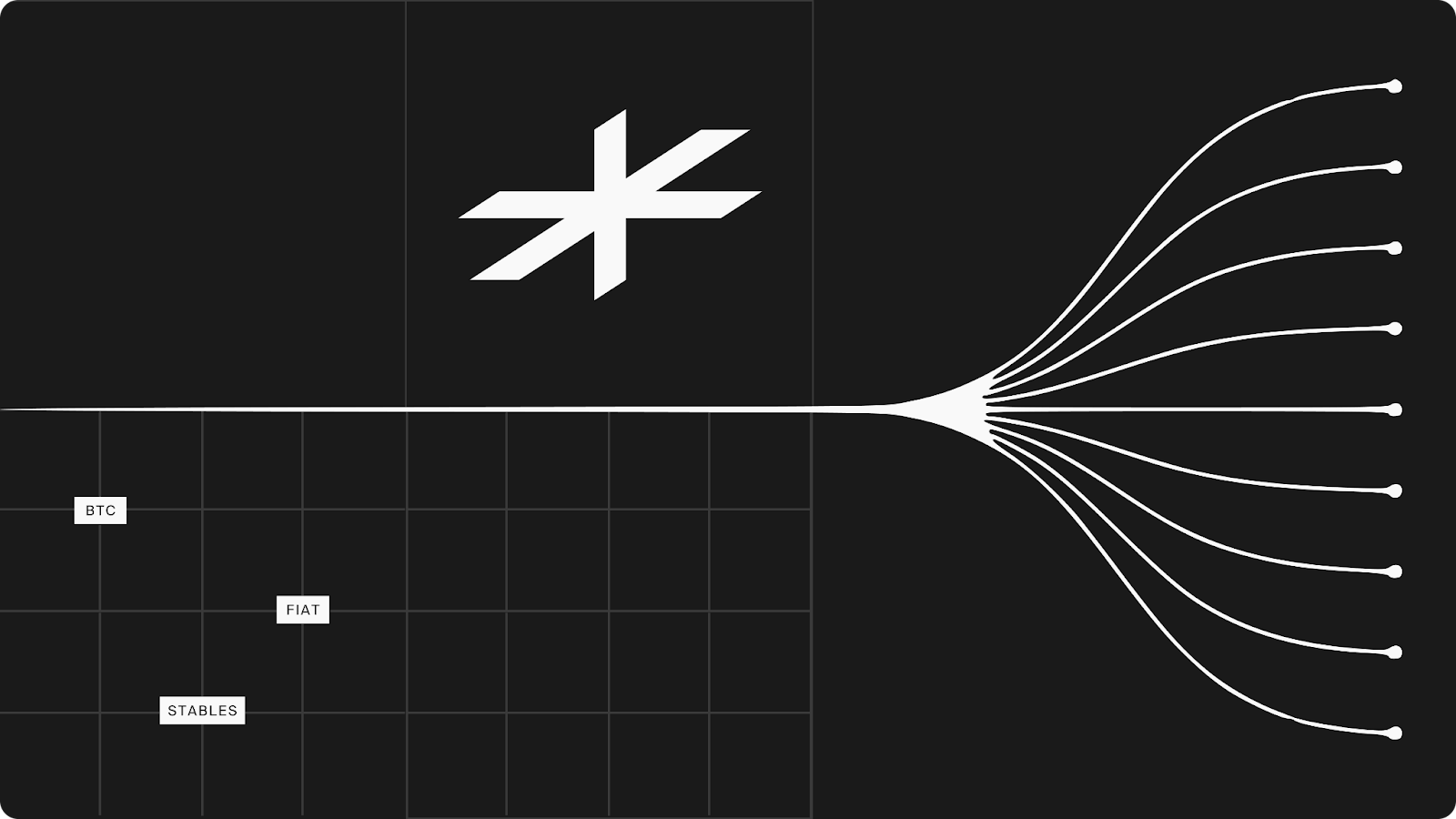
Lightspark Grid settles value globally across fiat, stablecoins, and Bitcoin through a single API. Here's how it maps to the evaluation criteria above.
Multi-Rail Orchestration with Lightning-Powered Settlement
Grid routes payments across a network of "Grid switches"—fiat instant rails, crypto rails, and hybrid combinations—optimizing each transaction for speed and cost. Bitcoin's Lightning Network serves as the core global settlement layer: instant, 24/7/365 finality with fees measured in fractions of a cent, while counterparties transact entirely in fiat. Settlement doesn't depend on banking hours or time zones—a payment initiated at 2 AM Saturday settles in seconds.
This is the "hybrid model" that landscape analyses recommend—blockchain rails for settlement combined with fiat infrastructure for compliance and local delivery—implemented as a production API.
65 Countries on Local Instant Rails
Grid connects to local instant payment schemes across 65 countries: SEPA Instant (32 European countries), PIX (Brazil), SPEI (Mexico), UPI and IMPS (India), Faster Payments (UK), PayNow and FAST (Singapore), and ACH/Wire/RTP/FedNow (US). Bank transfers cover additional countries across Africa and Asia-Pacific, including Thailand, Malaysia, and the Philippines.
Grid auto-selects the optimal local rail based on currency, country, and amount.
Transparent Quoting with Locked Rates
Grid's quote system locks exchange rates and itemizes every fee component. You can lock either the sending or receiving side.
Example quote response:
No hidden spreads. The exchange rate in the quote is the rate that executes.
Built-In Compliance
AML/KYC screening is embedded in every transaction. Grid offers two compliance models: hosted KYC/KYB for non-regulated platforms and bring-your-own compliance for regulated entities. Both include automated transaction monitoring across US and European jurisdictions. Hosted onboarding reduces friction and improves customer experience for counterparties completing verification.
Developer-First Integration
Grid provides REST APIs, a Postman collection, and a public GitHub repo. The sandbox mirrors production including webhooks and failure modes. Unlike legacy SWIFT messaging or systems requiring ISO 20022 format migrations, Grid's API functions are purpose-built for modern settlement—no translation layers needed.
The quote-to-execution flow is two API calls—or one with immediatelyExecute: true. Same-currency transfers use /transfer-out for single-call execution. Real-time webhooks track each status change through to final settlement, and Grid publishes a public integration roadmap so you can plan around upcoming corridors and features.
Closing the Loop: Collection and Pay-In
The same infrastructure handles the reverse direction. Where settlement sends funds across borders, pay-in capabilities accept funds from international counterparties.
- Counterparty sends payment in their local currency
- Grid converts and settles to your internal account
- Funds are available for onward settlement or withdrawal
Supporting both directions through one API creates a closed loop. B2B platforms can receive international payments and settle international obligations through a single integration.
What It Actually Takes to Build Settlement Infrastructure
Some teams consider building real-time cross-border settlement in-house. Here's what that requires:
- Direct connections to local instant payment rails across 65+ countries
- Multi-rail routing engine with dynamic path selection and automatic failover
- Blockchain integration for settlement bridging (Lightning Network, stablecoin rails, liquidity management)
- Real-time FX conversion with pre-positioned liquidity across corridors
- AML/KYC infrastructure with real-time screening across jurisdictions
- Regulatory licenses in each jurisdiction—navigating requirements from central bank authorities to financial conduct regulators
- 24/7/365 operations, monitoring, and incident response
For most companies, this represents 18–24 months of engineering and significant ongoing operational overhead. The math rarely justifies it unless real-time settlement infrastructure is your core product.
The alternative: integrate with an API that handles multi-rail routing, compliance, FX, and local delivery. Go from evaluation to production in weeks.
From Sandbox to Production
Grid offers a sandbox environment that mirrors production—test quoting, funding, execution, and webhooks without moving real funds.
To start integrating:
