.png)

Bitcoin rewards have rapidly evolved from a niche perk into a mainstream consumer incentive model. As digital assets become more widely understood and as businesses seek ways to create deeper engagement, Bitcoin has emerged as a compelling rewards medium. Unlike cashback points or fiat loyalty credits, Bitcoin offers participation in a global, scarce, open monetary network, making each reward feel more like an investment than a discount.
But behind every successful Bitcoin rewards experience is a complex foundation of payments infrastructure, custody considerations, regulatory compliance, and user-experience design. Today, businesses can build these programs more efficiently than ever thanks to innovative payment networks like Lightspark Grid, which abstracts away crypto complexities and enables rapid, low-cost settlement to users worldwide.
This article breaks down what Bitcoin rewards are, how they work, the infrastructure needed to support them, and how Grid enables scalable, compliant, instant Bitcoin-denominated rewards delivery.
Understanding Bitcoin Rewards
Bitcoin rewards allow consumers to earn Bitcoin through everyday actions, typically purchases, platform usage, referrals, or loyalty activities. These rewards differ fundamentally from traditional incentives because they distribute an asset rather than a currency that depreciates or a point that loses value outside a closed ecosystem.
What Makes Bitcoin Rewards Unique
- They provide exposure to a global digital asset rather than a proprietary points system.
- Bitcoin can be held, transferred, or converted, giving users far more freedom than closed-loop rewards.
- Denominations can be tiny, as small as satoshis, making micro-rewards practical.
- Rewards feel like ownership, not just discounts, increasing perceived value and long-term customer engagement.
How Bitcoin Rewards Work
Bitcoin rewards programs can operate through several delivery models. The business chooses which fits its design, regulatory footprint, and user experience goals.
Cashback in Bitcoin
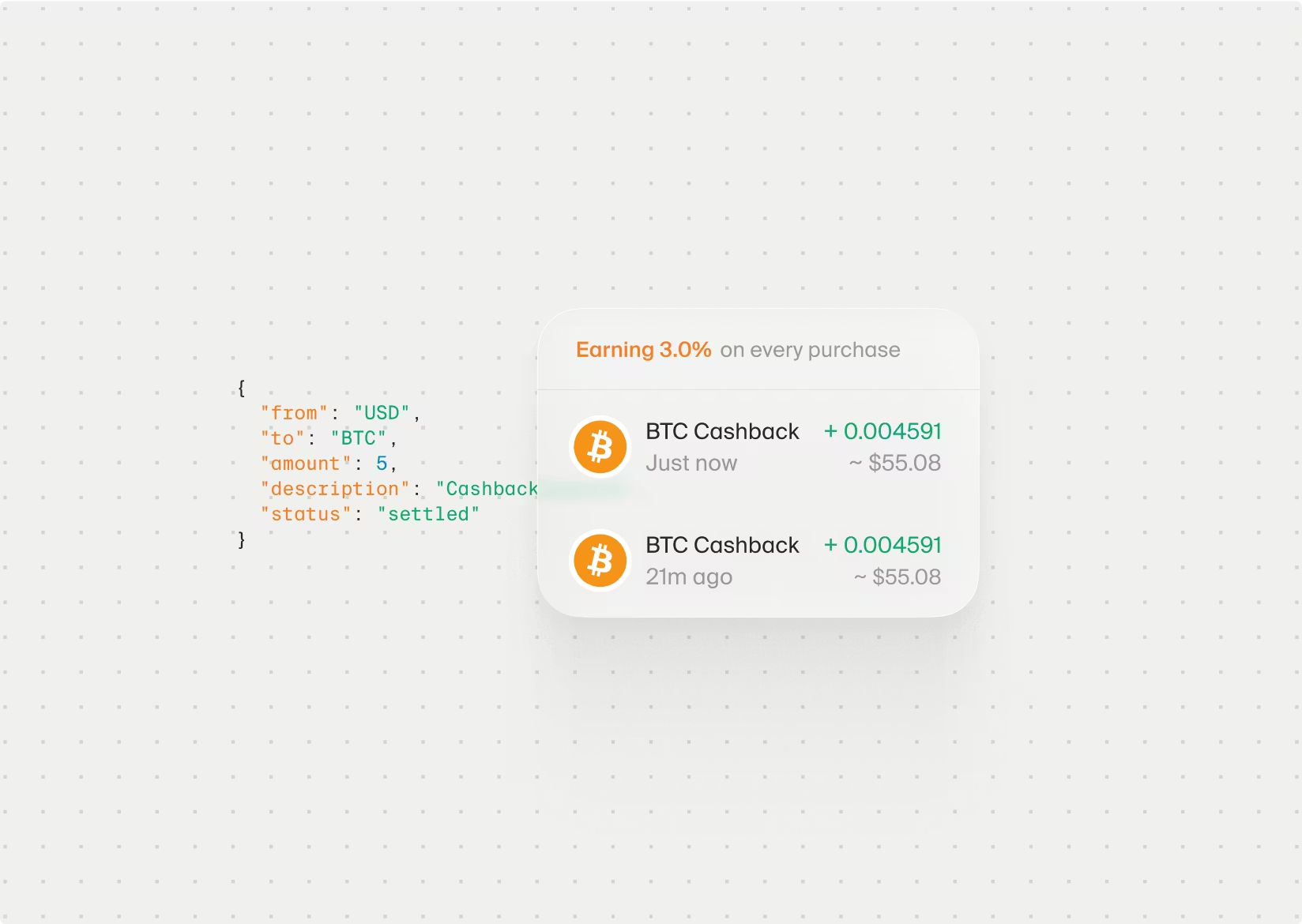
Instead of earning fiat cashback, users receive Bitcoin credited to their account or wallet. This model mimics the structure of traditional cashback but changes the medium to a digital asset.
Points That Convert to Bitcoin
Businesses can also distribute internal loyalty points and allow conversion to Bitcoin when users redeem. This creates flexibility for reward accrual while offering an attractive Bitcoin redemption path.
Shopping Rewards via Integrated Partners
Some programs tie users’ purchases to automated Bitcoin accrual through browser extensions or shopping portals that detect eligible transactions and credit sats instantly.
Core Infrastructure of a Bitcoin Rewards Ecosystem
A successful Bitcoin rewards experience depends on strong infrastructure operating behind the scenes. This foundation includes wallet architecture, custody systems, redemption pathways, liquidity management, security controls, and compliant onboarding. When these elements are well designed, Bitcoin rewards feel simple and reliable to users, even though the underlying systems are complex.
Wallet Architecture
Bitcoin rewards are typically delivered into either custodial wallets managed by the platform or self-custody wallets where users control their own private keys. Custodial wallets reduce friction and simplify onboarding, especially for users who are new to Bitcoin. Self-custody wallets align more closely with Bitcoin’s principles of ownership and autonomy, but they can introduce additional usability challenges that platforms must carefully manage.
Custody Systems
Most businesses rely on third-party custodians, crypto-native wallet providers, or specialized infrastructure platforms to securely hold Bitcoin until it is distributed. Choosing the right custody partner is critical, as these providers must meet high standards for security, regulatory compliance, and operational reliability in order to support a rewards program at scale.
Redemption & Liquidity
Redemption flexibility strongly influences the perceived value of Bitcoin rewards. Users may want to convert Bitcoin into fiat, transfer it to a personal wallet, or spend it through cards or exchanges. To support these options, rewards programs must maintain sufficient liquidity, ensure predictable settlement, and clearly communicate any conversion fees so rewards remain easy to use and trustworthy.
Operational Considerations for Bitcoin Rewards
Implementing Bitcoin rewards requires deliberate planning, especially around costs and program controls. While Bitcoin incentives offer clear benefits, they also introduce operational considerations that must be defined upfront to ensure a sustainable and user-friendly experience.
Fees and Transaction Costs
Bitcoin transactions may incur network fees depending on on-chain conditions or the use of Lightning settlement. In addition, rewards programs can involve platform service fees, conversion costs, or transfer and withdrawal charges. Clearly disclosing these fees is essential, as transparency builds trust, reduces confusion, and encourages long-term engagement.
Program Limits
Most Bitcoin rewards programs establish limits to manage risk and operational costs. These can include maximum daily or monthly rewards, minimum redemption thresholds, or transaction size caps. Clear boundaries help prevent abuse, support compliance, and make costs more predictable, creating a fair and reliable experience for both users and operators.
Eligibility Requirements
These typically include age restrictions, supported geographies, and identity requirements depending on a platform’s regulatory obligations.
Security, Compliance, and Taxation
Any program distributing Bitcoin must maintain strong security and regulatory safeguards. Because Bitcoin rewards represent real value, protecting funds and meeting compliance requirements are essential.
Security Controls
A secure Bitcoin rewards program typically includes:
- Multi-factor authentication to reduce the risk of account takeovers
- Encryption to protect sensitive user and transaction data
- Fraud monitoring to detect suspicious activity in real time
- Regular infrastructure audits to identify vulnerabilities and ensure system integrity
Since rewards involve real assets rather than points, security must be proactive, not reactive.
Regulatory Compliance
Bitcoin rewards platforms are generally required to support:
- KYC (Know Your Customer) processes for user identity verification
- AML (Anti-Money Laundering) controls to prevent illicit activity
- Transaction monitoring to flag unusual or high-risk behavior
Many programs rely on compliance partners or payments infrastructure providers to handle these requirements efficiently.
Tax Implications
Bitcoin rewards are often treated as taxable income. Programs should provide:
- Clear tax guidance to help users understand reporting obligations
- Basic reporting tools to track rewards over time
- Transparent valuation at the time rewards are issued
This approach helps users stay compliant while reducing confusion and support burden.
Lightspark Grid: Modern Infrastructure for Bitcoin-Powered Rewards
Lightspark Grid is a global payments network and unified API that enables developers and businesses to send, receive, and settle value, including Bitcoin, quickly and affordably across borders. It abstracts away blockchain infrastructure and offers simple, consistent payment primitives regardless of currency.
Grid’s design is especially well-suited for Bitcoin reward distribution because it combines speed, efficiency, regulatory alignment, and payout flexibility.
Below is how Grid enhances and modernizes Bitcoin rewards programs using the accurate capabilities reflected in the linked documentation.
Instant, Low-Cost Bitcoin Delivery Using a Unified Global API
Grid allows platforms to send payouts, including Bitcoin-denominated rewards, through one consistent API. Businesses do not need separate integrations for crypto, fiat, or cross-border payments.
- Grid handles routing, FX, settlement, and global delivery.
- The underlying settlement can use Lightning or local payment rails, but this is abstracted away.
- Developers can deliver rewards instantly to users around the world without becoming experts in Bitcoin payments.
This means a rewards platform can distribute sats to users globally as easily as sending JSON to an endpoint.
Payouts to Custodial or Self-Custody Wallets
Grid enables flexible payout delivery across a range of destinations, allowing rewards programs to meet users where they already store and use value. Rather than forcing a single custody model, Grid supports multiple payout endpoints through a unified API, giving platforms the ability to offer choice without increasing operational complexity.
Grid enables payouts to:
- In-app custodial wallets, when the platform chooses to manage user balances internally and provide a more guided, low-friction experience
- External accounts, including crypto or fiat endpoints connected through payout or on-ramp and off-ramp partners
- Self-custody Bitcoin wallets, allowing users to receive sats directly into wallets they control
A key advantage of Grid is that it abstracts the underlying payment and settlement mechanics. The platform initiating the payout only needs to specify the destination and amount. Grid handles routing, Lightning Network interactions, settlement, and confirmation behind the scenes. This means rewards programs do not need to operate Lightning nodes, manage liquidity, or maintain blockchain infrastructure in order to deliver Bitcoin rewards.
This architecture is especially valuable for rewards programs that want to support self-custody as a differentiator. By using Grid, platforms can offer direct-to-wallet Bitcoin rewards that align with Bitcoin’s principles of user ownership and autonomy, without taking on the complexity, security risk, or operational burden of building and maintaining wallet infrastructure themselves.
No Need to Build or Maintain Bitcoin Infrastructure
Grid clients do not need to:
- Manage Lightning liquidity or channel balances
- Operate or maintain Bitcoin or Lightning nodes
- Build custom settlement or reconciliation systems
- Interface directly with multiple FX providers or banking partners
Instead, Grid provides:
- One unified settlement layer that abstracts underlying payment rails
- One operational API for sending, receiving, and tracking payouts
- Full transparency into fees, routing, and real-time payment status
- Unified ledgering across currencies to simplify reporting and reconciliation
This level of simplification dramatically lowers engineering overhead, reduces operational risk, and makes it significantly easier for rewards programs to scale Bitcoin payouts globally.
Global Reach With Predictable FX and Settlement
A rewards platform can reach users across dozens of countries by relying on Grid’s global payment infrastructure rather than building region-specific systems. Grid provides the underlying payout rails needed to move value across borders efficiently, along with built-in handling for foreign exchange where conversions are required. It also supports compliance workflows through integrations that help platforms meet regulatory expectations in different markets, without forcing teams to manage those requirements independently in every region.
In addition, Grid offers end-to-end transaction tracking, giving platforms clear visibility into payment status from initiation through settlement. Together, these capabilities make it possible to operate a Bitcoin rewards program in regions that have historically been difficult to support due to slow settlement times, high fees, or fragmented cross-border payment infrastructure.
Compliance and Risk Management Built for Regulated Partners
Grid is designed to integrate smoothly with regulated financial institutions. It supports KYC/KYB, AML monitoring, and sanctions screening workflows at the network layer.
Rewards platforms can rely on Grid’s compliance-friendly architecture rather than building their own global compliance engines.
The Future of Bitcoin Rewards Powered by Global, Instant Infrastructure
Bitcoin rewards are gaining momentum because they deliver real, ownable value, but scalability depends on infrastructure that is fast, compliant, global, and developer-friendly.
Lightspark Grid provides exactly that foundation:
- Instant global settlement
- Unified API across currencies
- Flexible wallet delivery options
- Compliance-ready architecture
- Invisible crypto complexity
Grid enables businesses to focus on user experience, loyalty design, and growth, without getting bogged down in blockchain operations or cross-border payment mechanics.
As Bitcoin adoption accelerates, the rewards landscape will expand further: e-commerce incentives, card rewards, creator monetization, gaming, subscription perks, gig-economy payouts, and more.
With modern infrastructure like Grid powering delivery, Bitcoin rewards can finally scale into a mainstream, global, seamless incentive layer, one that makes digital asset ownership accessible to millions.
