Lightspark forB2B payments
Pay suppliers, partners, and merchants in 65+ countries on local rails. The invoice amount locks at quote; settlement confirms itself.
Lightspark API
(0, 0, 0)
The problem
The invoice is exact. The wire is anything but.
Paying a business abroad still usually means a wire: three to five days in transit, lifting fees subtracted along the way, and an FX rate nobody agreed to. The supplier invoiced an exact amount and received something else, so someone opens a ticket, and accounts payable spends month end explaining the difference.
Multiply that across a supplier base and it becomes an operating cost of its own: banking partners per region, spreadsheets tracking what settled, payment runs timed around cutoffs, and working capital parked as float because nobody trusts the transit time.
How it works
Counterparties register once. Every invoice is two calls.
Onboard each supplier, partner, or merchant once as a business counterparty, with their banking details and currency attached. Collect the details over the API from your AP system, or let hosted onboarding gather them for you. From then on, each one is a destination you pay with a single call.
 BRL
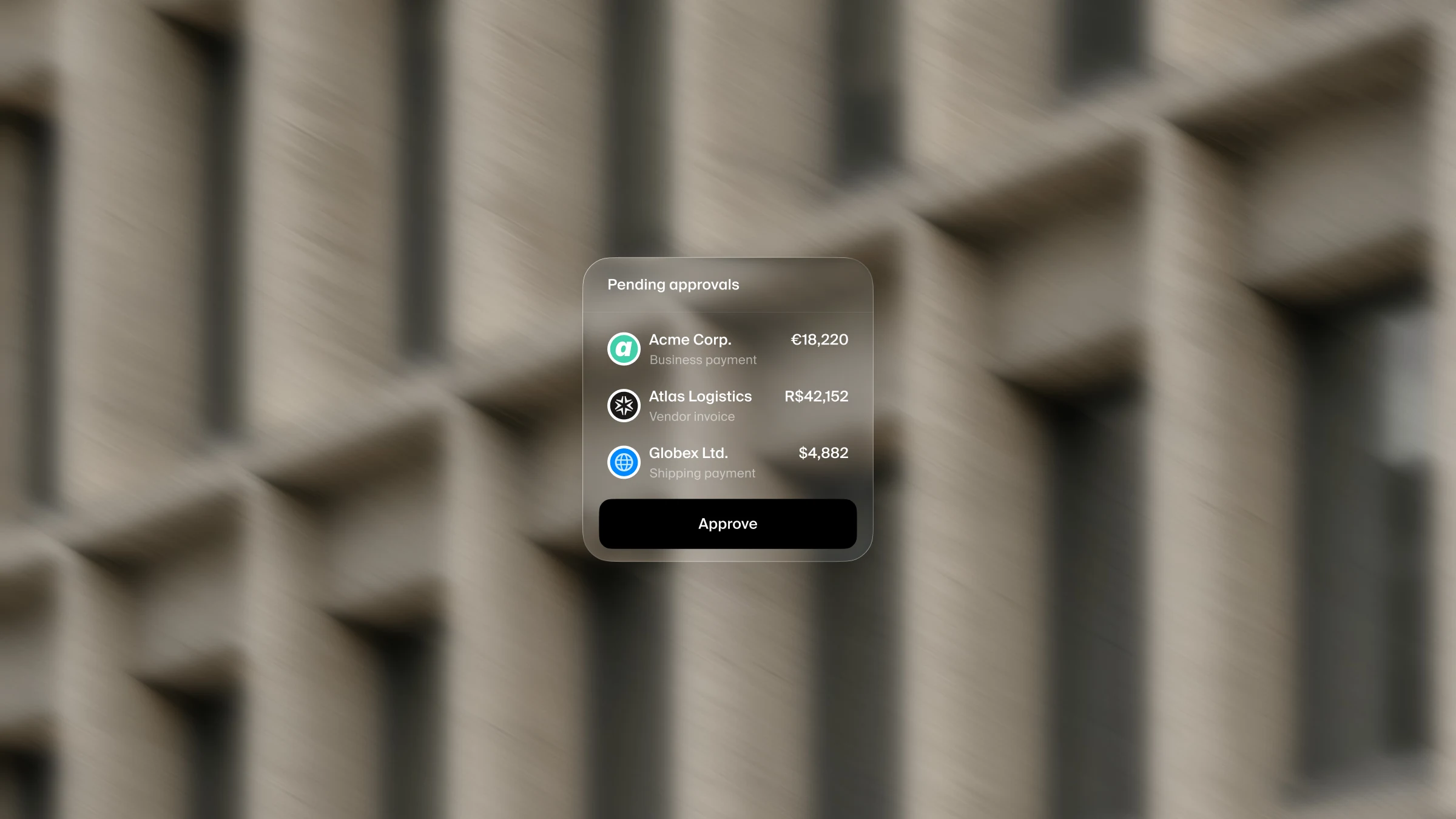
BRLEach invoice gets a quote with the receiving side locked: the counterparty receives exactly what the invoice says, the API calculates the sending amount, and every fee is visible before you commit. A delayed approval never executes on a stale rate; expired quotes recreate instantly at a fresh one.
Execution settles on local rails in 65+ countries: PIX in Brazil, UPI in India, SEPA in Europe, and settlement confirms over webhooks, so your AP system knows a payment landed without anyone asking the bank. Fund from held balances, or attach payment instructions so the payout executes the moment your money arrives.
 EUR
EUR VND
VND USDB
USDB THB
THB ZAR
ZAR INR
INR MXN
MXN GBP
GBP NGN
NGN PHP
PHP AED
AEDCapabilities
Built for invoices, not just transfers.
One integration pays businesses in 65+ countries on domestic rails, with receiving-side locks for invoice-exact amounts and every payment reporting its status until it lands.
Pay suppliers, partners, and merchants into bank accounts, wallets, and mobile money providers in 65+ countries, settled in local currency.
- Austria
- Bangladesh
- Belgium
- Benin
- Brazil
- Bulgaria
- Cameroon
- China
- Colombia
- Croatia
- Cyprus
- Czech Republic
- Denmark
- Dominican Republic
- Egypt
- El Salvador
- Estonia
- Finland
- France
- Germany
- Ghana
- Greece
- Guatemala
- Haiti
- Honduras
- Hong Kong
- Hungary
- Iceland
- India
- Indonesia
- Ireland
- Israel
- Italy
- Ivory Coast
- Kenya
- Latvia
- Liechtenstein
- Lithuania
- Luxembourg
- Malawi
- Malaysia
- Malta
- Mexico
- Morocco
- Netherlands
- Nigeria
- Norway
- Pakistan
- Philippines
- Poland
- Portugal
- Romania
- Rwanda
- Senegal
- Singapore
- Slovakia
- Slovenia
- South Africa
- Spain
- Sweden
- Switzerland
- Tanzania
- Thailand
- Uganda
- United Arab Emirates
- United Kingdom
- United States
- Vietnam
- Zambia





































































Lightspark auto-routes each payment to the optimal rail for the currency, country, and amount. Instant where the rail supports it.
Lock the receiving amount so the counterparty gets exactly what the invoice says; the API calculates the sending side. Quotes hold the rate for 1 to 15 minutes depending on corridor.
Fund from held balances or with just-in-time payment instructions. Balances credit the moment funds arrive.
Business verification, sanctions screening, risk review, and the compliance requirements attached to each supported corridor. Regulated platforms can run KYB in their own systems instead.
Quote, execute, webhook. Every payment reports status through signed webhooks, so settlement reconciles against invoices instead of a support queue.
Integration
Onboard the counterparty once. Then quote and execute.
The objects are the ones your AP system expects: customers, accounts, quotes, transactions, and webhooks. Register the business and its bank account once; every invoice after is a quote with the receiving side locked, then an execute, with settlement confirmed over webhooks. The sandbox funds instantly, so the whole flow can be tested before production money moves.
Get started
Close the books on wire transfers.
Start with one API, a sandbox, and the objects you already know: customers, accounts, quotes, transactions, and webhooks.